 USD
USD  Swedish krona (SEK SEK)

TL;DR
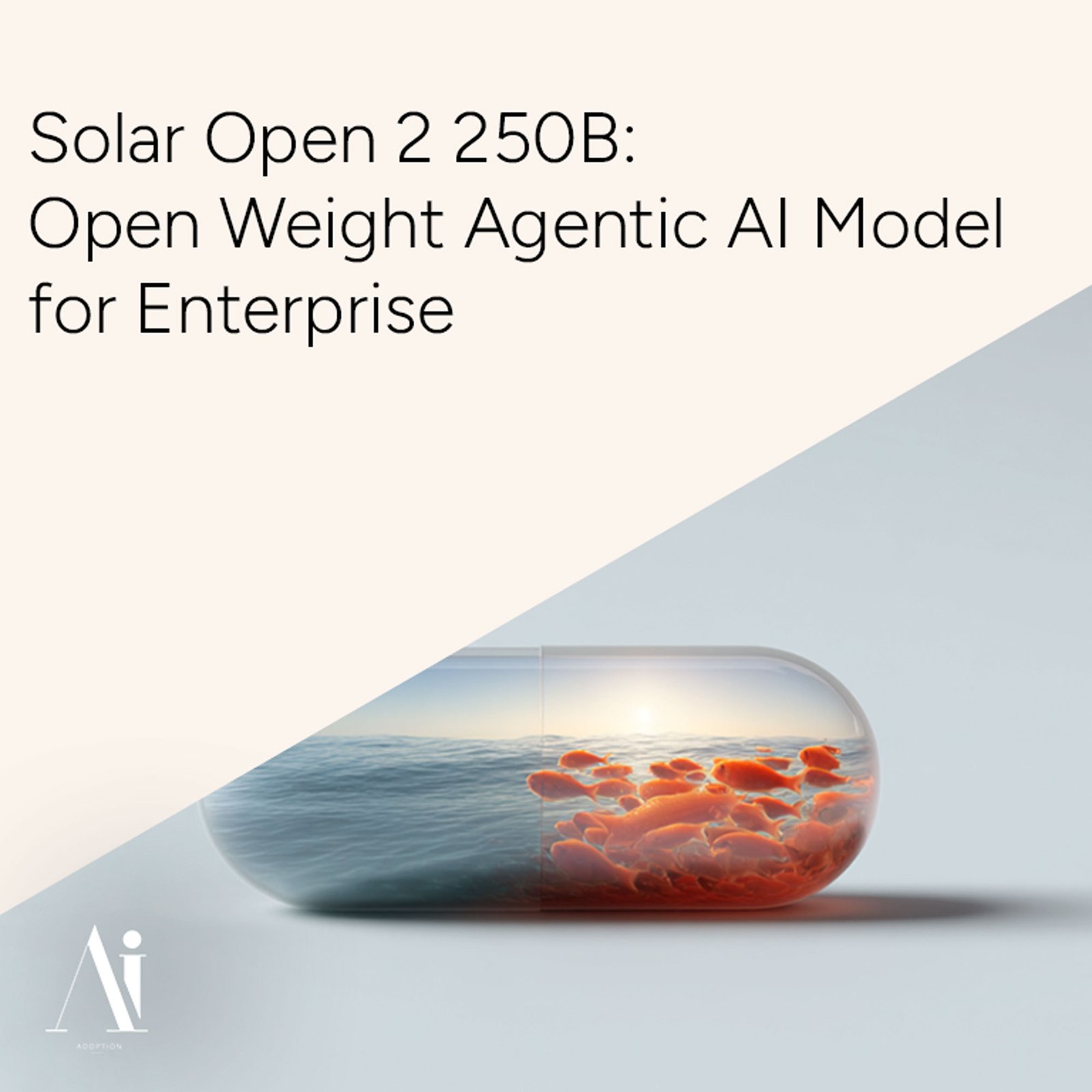
Solar Open 2 250B is Upstage’s new open weight agentic AI model built for real business work. It uses a 250 billion parameter Mixture of Experts design with 15 billion active parameters per token, a 1 million token context window, and multilingual coverage across English, Korean, and Japanese. This guide explains what it is, why the architecture matters, and how enterprise teams can deploy it inside document heavy workflows, coding pipelines, and multilingual operations.
ELI5 Introduction: A Practical Assistant for Real Work
Imagine a very smart office helper that can read an entire mountain of documents, remember a huge conversation, and then finish complicated tasks without losing the thread. That is the basic idea behind Solar Open 2 250B. It is designed to act like a practical assistant for real work, not just answer short questions.
The reason it is interesting is that it uses a clever setup called Mixture of Experts, so only part of the model turns on for each token. That helps it stay powerful while keeping inference more efficient than a huge dense model of similar scale.
Solar Open 2 250B is one of the most notable open weight model releases of 2026 because it combines scale, long context, and agent focused design in a way that is clearly aimed at real business use cases. Upstage positions the model as a sovereign foundation model for agents, with open weights released publicly and a technical report describing the architecture, training strategy, and evaluation approach.
What makes this release especially relevant for AI teams is not just the parameter count. The model is optimized for repeated tool use, long horizon reasoning, office productivity, and multilingual workflows, which makes it directly relevant to enterprise ai automation, content operations, and developer productivity.
Detailed Analysis: Architecture, Positioning, and Performance
What Solar Open 2 250B Is
Solar Open 2 is a 250B A15B mixture of experts llm, meaning it has 250 billion total parameters but activates about 15 billion parameters per token during inference. This design matters because it offers the expressive capacity of a much larger model while avoiding the full compute burden on every forward pass.
The model is built for long horizon agentic tasks, including office work, coding, and document intensive workflows. Upstage also describes it as the base model for agents in real work environments, which is a strong signal that the product strategy is centered on practical execution rather than benchmark chasing alone.
Why The Architecture Matters
The most important technical story is the hybrid attention design. Solar Open 2 interleaves three linear attention layers with one softmax attention layer, uses no positional encoding in the linear layers, and supports a 1M token context window. That is a major step for agent systems because it allows the model to hold entire task trails, long conversations, and large document sets in a single context. A capable long context llm unlocks workflows that were previously impractical because the model can keep more of the problem in view at once.
This design also reduces memory pressure because only 12 of the 48 layers retain a KV cache, cutting long context memory growth relative to an all softmax stack. In practical terms, that means enterprises can explore long document analysis, software debugging, and workflow orchestration without hitting the usual context bottlenecks so quickly.
Market Position and Competitive Angle
Solar Open 2 lands in a market where frontier models are increasingly evaluated not just on raw knowledge, but on whether they can act reliably in workflows. Upstage claims strong results on MMLU Pro, LiveCodeBench, SWE Bench Verified, IFBench, MCP Atlas, and APEX Agents, with particularly strong performance in Korean benchmarks and office work scenarios.
The strategic implication is clear. Open weight agentic ai models are moving from good enough chat toward deployable worker intelligence. For companies that need control, customization, and local deployment, that changes the economics of adoption because an open weight agent model can reduce dependency on closed APIs while preserving commercial flexibility.
Performance Signals
Upstage and third party summaries report benchmark scores including 86.2 on MMLU Pro, 92.4 on LiveCodeBench, 70.4 on SWE Bench Verified, 80.0 on IFBench, and 58.2 on MCP Atlas. On Korean evaluations, the model is reported to rank at or near the top among compared systems, including closed tier models, which suggests a deliberate specialization advantage.
These figures should be treated as vendor reported claims until independent replication becomes more widely available, but they still tell an important story. The market is starting to reward models that blend broad capability with domain specific excellence instead of trying to dominate every benchmark equally.
Related service: We build custom AI agents for customer support, lead qualification, and business automation. Deployed and working within 72 hours. Learn About AI Agents →
Commercial and Deployment Implications
Solar Open 2 is released under the Upstage Solar License, which permits commercial use and derivative development with attribution requirements. That matters because licensing is often the decisive factor for enterprise adoption, especially where product teams need governance, security review, and the ability to fine tune or host internally.
Deployment cost is another key theme. Reports suggest the model can run on four NVIDIA H200 GPUs in BF16 or on two H200s with quantization, while third party estimations indicate much higher memory needs for uncompressed inference. The broader point is that even a highly efficient open model still requires serious infrastructure planning, especially if you want long context and production grade throughput.
Implementation Strategies for Production Deployment
Where To Use It
Solar Open 2 250B is most compelling for workflows that involve long context, repeated tool use, and document heavy processing. Good candidates include enterprise research assistants, customer support automation, analyst copilots, software engineering helpers, and multilingual content operations.
A strong rule of thumb is to map the model to tasks where memory and multi step reasoning matter more than casual conversation. If your workflow depends on reading many files, keeping track of state, and producing structured outputs, Solar Open 2 is aligned with that need. This is the difference between agentic ai vs ai agents in practice: the model is not just a chat interface, it is a reasoning engine wired into your process.
How To Deploy It
A practical deployment plan should start with a pilot on one high value workflow, not a company wide rollout. For example, an internal operations team could use Solar Open 2 to review long policy documents, summarize action items, and draft responses across English and Korean.
From there, teams should benchmark four areas before production:
- Latency under realistic context lengths, not synthetic short prompts.
- Tool calling reliability, measured over hundreds of runs with varied inputs.
- Cost per completed task, not cost per token, so the economics reflect real workflow value.
- Safety and output consistency across languages, especially for multilingual deployments.
Ready to deploy an agentic AI model inside your workflows? Our Custom AI Agent Development Service handles architecture, tool integration, and deployment so your team can focus on outcomes. Starting at $798.
How To Evaluate ROI
The right ROI question is not whether the model is cheaper than everything else. It is whether it reduces total workflow cost by compressing reading time, drafting time, review time, and rework. That framing is especially useful for agentic tasks, where one successful run can replace many manual handoffs.
For content teams and AI engineering groups, the best ROI often comes from combining the model with strong prompts, retrieval systems, and workflow guardrails. The model becomes the reasoning engine, while your data layer and process design determine output quality.
Best Practices and Case Studies for Agentic Deployments
Best Practices
The strongest implementation pattern is to constrain the model to a narrow domain before expanding its responsibilities. Solar Open 2 is optimized for agentic behavior, but like any large model, it will perform better when paired with clear tools, explicit schemas, and structured input formats.
Other best practices for a production grade agentic ai model deployment include:
- Ground long document tasks with retrieval so the model reasons over your source of truth, not its training data.
- Add tool permission checks for any action that writes to a system of record.
- Keep human review for high stakes outputs, including contracts, financial figures, and customer facing communication.
- Measure task completion, not just response quality, so evaluation aligns with business value.
Case Example One: Multilingual Operations
A multilingual operations team can use Solar Open 2 to handle document review across English, Korean, and Japanese. The value comes from combining long context with multilingual strength, which is particularly useful when the same workflow spans contracts, internal reports, and external communication.
In this type of setup, the model can read the source material, extract key points, draft summaries, and prepare a final action list for human approval. That is exactly the sort of workflow where agentic models create measurable time savings.
Have a multilingual or document heavy operation that could run faster with automation? Our AI Workflow Automation Service maps your existing process, integrates the right model, and ships a working pipeline in weeks. Starting at $498.
Case Example Two: Software Engineering Copilot
A software team can use Solar Open 2 for code assistance, issue triage, and step by step debugging. Its reported LiveCodeBench and SWE Bench Verified performance suggest it is particularly relevant to code oriented workloads rather than only general chat.
The most effective use case is not replacing engineers, but reducing the time spent on repetitive reading, test generation, and structured analysis. That is where a long context model can turn a complex codebase into something much easier to navigate.
Actionable Next Steps
This Week
Start by identifying one workflow where long context and repeated tool use create obvious friction. Then test Solar Open 2 against that workflow using a fixed prompt set, structured outputs, and a human review layer. The point is to generate data, not to declare a winner in the first sitting.
This Month
Compare Solar Open 2 against your current baseline on:
- Output quality measured on your own test set, not public benchmarks.
- Cost per task, including infrastructure, tokens, and human review time.
- Latency at production context lengths.
- Deployment complexity, including quantization, serving, and observability.
- Language performance across the languages your business actually uses.
Next Quarter
Decide whether the model should serve as your primary agent engine, a specialist fallback, or a localized deployment option for sensitive work. That decision should be based on workflow value, not model hype. If the numbers support it, expand from pilot to two or three adjacent workflows and lock in a monitoring plan before scaling further.
Conclusion
Solar Open 2 250B is important because it moves open weight AI closer to real operational use. With long context, efficient MoE inference, strong multilingual positioning, and an explicitly agentic design, it is a serious option for teams building practical AI systems. It is also a signal about where the industry is heading: models that can do work, not just talk about it.
The bigger lesson is that the next phase of AI competition will favor models that reduce total workflow cost and increase completion rates. For organizations that care about control, deployment flexibility, and workflow automation, Solar Open 2 is a model worth tracking closely and testing on real tasks this quarter.
Want a strategic roadmap for adopting agentic AI in your organization? Our AI Consulting and Strategy Service maps model options, workflow priorities, and rollout sequencing so your team ships value, not experiments. Starting at $998.
Want Your Own AI Agent?
We build custom AI agents for customer support, lead qualification, and business automation. Deployed and working within 72 hours.
Learn About AI Agents