 USD
USD  Swedish krona (SEK SEK)

TL;DR
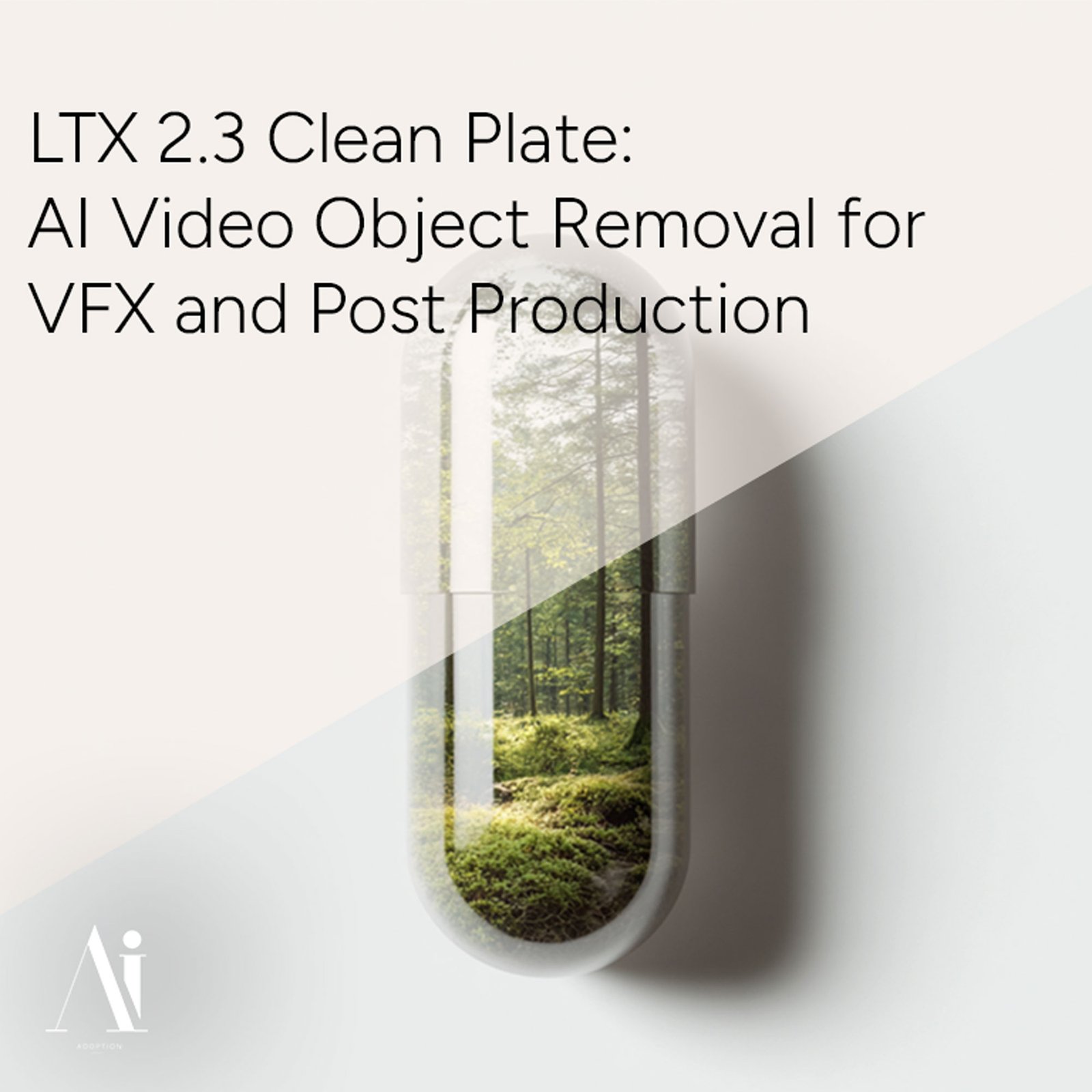
LTX 2.3 Clean Plate is a specialized video to video LoRA built to remove people, pedestrians, vehicles, and other moving foreground objects from footage while rebuilding the background behind them. It is designed for VFX, compositing, and post production workflows that need a clean plate without manually masking every frame.
ELI5 Introduction
Imagine filming a street scene, but later you want the same video with the people and cars erased so the street looks empty. LTX 2.3 Clean Plate is an AI tool that tries to do exactly that by looking at the video, finding the moving objects, and filling in the missing parts of the scene as naturally as possible.
In simple terms, it is like asking an artist to repaint the background after someone walks in front of the camera. The difference is that the AI does this across many frames at once, so the result can stay consistent over time instead of looking like a patchwork of stitched edits.
This matters for video teams, VFX artists, and marketing creators because the old way of doing this work was slow and manual. Every frame had to be masked, tracked, and painted by hand. A specialized AI model that handles the busy work turns hours of cleanup into minutes of review, which changes what a small team can ship.
Detailed Analysis
What LTX 2.3 Clean Plate is
LTX 2.3 Clean Plate is an IC LoRA for the LTX 2.3 22B video model, which means it adapts the base model toward one focused task: producing clean background plates from video. The model is aimed at removing people, pedestrians, vehicles, and similar moving subjects while preserving static scene details such as architecture, roads, plants, and ground markings.
That focus makes it especially useful for VFX clean up, compositing workflows, background plate generation, scene extension and digital set work, and removing distractions from real world footage. It is not a general purpose video generator dressed up with an editing prompt. It is a targeted production utility.
Why it matters now
Video teams have long relied on manual rotoscoping, frame by frame masking, and hand paint cleanup to remove unwanted elements. LTX 2.3 Clean Plate is notable because it pushes this work toward automation, reducing the need to draw masks by hand and making it easier to process whole clips as a single pass rather than a stitched series of edits.
Production bottlenecks are usually not about generation quality alone. They are about time, iteration speed, and how easily a tool fits into an existing pipeline. In that sense, Clean Plate is less about flashy effects and more about a practical productivity gain for editors, VFX artists, and AI video creators shipping paid work on a deadline.
How it works
The model operates in a video to video setup. You feed it source footage, and it generates a version of the same scene with moving foreground subjects removed while attempting to reconstruct the occluded background with temporal consistency across frames.
Key workflow traits: it does not require traditional masking in the basic setup, it is integrated into the LTX 2.3 IC LoRA ecosystem, it is available inside ComfyUI, and it is designed for footage where the background is meaningfully recoverable from the frames around it.
A useful way to think about it: the model is not merely deleting pixels. It is trying to infer what should have been behind the moving object if that object had not been there. That is why scene stability and clear background visibility matter so much to the final result. The model has to see enough of the environment across frames to plausibly rebuild the parts that were hidden.
Need AI video cleanup wired into your production pipeline?
Our AI Commercial and Video Creation Service builds LTX style clean plate and object removal workflows into your existing post production stack, so your team ships polished cuts without hand masking every frame.
How it differs from generic inpainting
Traditional video inpainting often requires careful masking, object tracking, or hand tuned per shot workflows. Clean Plate is different because it is described as a full frame subject removal solution that automatically targets moving foreground objects and rebuilds the hidden scene behind them without a manual mask setup for every clip.
Related service: We create 5 professional, high-quality AI images tailored for your products or website — delivered in 24 hours for just $100. Get 5 AI Images →
That difference is strategic, not just technical. In production settings, the hidden cost is usually operator time, not just software capability. A tool that reduces setup complexity can create a bigger workflow impact than a more flexible but cumbersome alternative, because it moves the bottleneck from skilled labor to review time.
What the model is best at
Based on the release descriptions, Clean Plate is strongest in scenes that contain pedestrians crossing streets, cars or motorcycles moving through frame, static architecture with temporary occlusions, ground planes like sidewalks and roads with visible plant life, and controlled camera movement where background continuity is still learnable across the clip.
It appears especially relevant for urban footage, VFX plates, location clean up, and scenes where the removed objects are transient rather than permanently embedded into the environment. If the subject you want to remove was only in the frame for a few seconds and the environment behind them is largely visible in other frames, the model has a strong chance of producing a usable plate.
Where it may struggle
Like most AI reconstruction tools, Clean Plate is likely to be less reliable when the background is heavily occluded, highly reflective, or rapidly changing. Scenes with complex motion, frequent viewpoint changes, or very little visible background information can make reconstruction harder, because the model has less evidence to infer what belongs behind the moving subject.
In practical terms, that means users should treat it as a strong cleanup and reconstruction assistant, not a guaranteed replacement for expert compositing on every shot. For final delivery work, human review still matters. The value shows up in the ratio of shots that finish cleanly with almost no manual touch up versus the small number that still need a compositor pass.
Market and workflow context
The release fits a broader trend in AI video: tools are moving from open ended generation toward targeted production utilities. Instead of asking models to create everything from scratch, creators increasingly want AI that solves specific pipeline problems such as object removal, relighting, upscaling, and shot extension.
That shift is important because production value comes from repeatability. A targeted tool like Clean Plate is easier to justify operationally than a broad model because its output maps directly to a known business task: making unusable footage usable, or speeding up a cleanup stage that otherwise consumes skilled labor hours that could be spent on more creative work.
Implementation Strategies
Start with the right footage
Use shots where the background is mostly static and the moving subjects are temporary occlusions. Street scenes, drive by footage, and location plates are strong candidates because the model can infer the hidden environment more plausibly from adjacent frames. Interior shots with clear architecture and controlled lighting also perform well.
Write prompts for the end state
The examples associated with LTX 2.3 workflows emphasize describing the empty desired scene rather than simply instructing the model to remove objects. In practice, that means framing the prompt around a clean, empty version of the same location with intact lighting, structures, and background detail. Say what should be there, not just what should not.
Use negative constraints carefully
For best results, explicitly exclude people, humans, body parts, shadows, and reflections if your workflow supports prompt control. The shared examples show that shadows and reflections can matter as much as the subject itself when the goal is a convincing clean plate. A plate that removes a person but leaves their shadow reads as broken to viewers.
Test on representative clips first
Before scaling into a project, test the model on a few different scenes that reflect your real production conditions. That will help you see whether it performs best on roads, interior spaces, or controlled exterior environments, and where manual cleanup may still be needed. Build a small internal reference set of pass and fail examples so the team learns to spot which shots are good candidates before running the model at scale.
Turn ComfyUI experiments into a repeatable video pipeline.
Our AI Workflow Automation Service designs and deploys the plumbing around tools like LTX 2.3 Clean Plate so ingest, prompt setup, model calls, output review, and delivery all run on a schedule instead of a hunch.
Best Practices & Case Studies
Operating rules that make Clean Plate pay off
A tight set of habits separates teams that get value from Clean Plate from teams that abandon it after two frustrating tests. Use footage with enough visible background for reconstruction. Keep camera movement as stable as possible when you can. Avoid expecting perfect recovery in highly reflective or crowded scenes. Review output frame by frame before using it in final compositing. Treat the tool as one stage in a pipeline, not a one click replacement for supervision.
These are not exotic rules. They are the same discipline good VFX teams already apply to manual cleanup work. The difference is that with an AI model in the loop, the review step becomes the expensive step instead of the paint step, and that changes how you staff a project.
Case study: urban commercial footage cleanup
A common use case is urban street footage where people and vehicles block a storefront, sidewalk, or roadway. Clean Plate can generate a cleaner plate that helps VFX teams replace signage, stabilize a background, or prepare a composite without reconstructing the entire shot manually. In a commercial production context, that means a director who captured a great performance in front of a busy background can now get a usable clean version of the same shot in hours instead of days.
Case study: location scouting and prep footage
Another useful scenario is location scouting or production prep, where a team wants a version of the shot without incidental traffic or passersby. In that context, the model turns a problem shot into a reusable background plate for later work. Producers can pre visualize a location scene with different lighting, blocking, or additional VFX layers on top of a clean base, without waiting for a controlled reshoot in the middle of the night.
Case study: creator and social content cleanup
Independent creators and social teams often shoot in public spaces where controlling background traffic is not realistic. Clean Plate lets a solo creator remove distracting passersby, drive by cars, or accidental extras from a shot that would otherwise need a reshoot or a heavy manual edit. For creators who ship multiple pieces per week, this is the difference between publishing a polished cut and burning the day on manual masking.
Actionable Next Steps
- Pick candidate clips. Identify a few shots from your library that contain moving people or cars over a mostly static background. Aim for variety in lighting and camera stability so your test represents real production conditions.
- Run a pilot in ComfyUI. Set up the LTX 2.3 Clean Plate workflow and process the pilot clips. Do not try to tune the model on the first pass. Just get output flowing end to end.
- Compare against manual cleanup time. Measure how long a comparable shot would take with your current manual process, and log the delta. This is the number that justifies the tool internally.
- Build a prompt template. Standardize a prompt structure centered on the desired empty scene and the negative constraints for people, shadows, and reflections. Reuse it across similar shots.
- Create a review checklist. Before publishing or delivering, check for shadow ghosting, reflection artifacts, background seams, and temporal flicker. A five item checklist done consistently catches almost every issue.
Not sure if AI video cleanup is worth the pilot?
Our AI Consulting and Strategy Service maps tools like LTX 2.3 Clean Plate to your actual production workload, sizes the time savings, and gives you a decision framework so you invest where the payoff is real.
Conclusion
LTX 2.3 Clean Plate is a focused, production friendly tool for removing moving subjects from video and reconstructing the background behind them. Its value lies in turning a traditionally manual VFX task into a faster, more repeatable workflow that fits modern AI video pipelines. It is not a magic replacement for skilled compositors, but it removes enough hand work to change how a small video team can staff a project.
For creators, editors, and VFX teams, the takeaway is simple. Use Clean Plate when you need a believable empty version of a scene, especially in footage with static infrastructure and temporary foreground motion. For best results, choose the right source footage, prompt for the final empty scene, and review output carefully before delivery. The teams that make it pay off will be the ones that pilot on a narrow use case first, build a review discipline, and only then scale across their catalog.
Need Professional AI-Generated Images?
We create 5 professional, high-quality AI images tailored for your products or website — delivered in 24 hours for just $100.
Get 5 AI Images