 USD
USD  Swedish krona (SEK SEK)
ELI5 Introduction
Imagine you have a coloring book page you like, but you want the character to turn around or reach for a cup without looking strange. Traditional tools try to redraw that page in one go and often bend arms or faces in weird ways. Chrono Edit treats this problem like a tiny video where the first frame is your original picture and the last frame is the edited one, so it can think about how things move in the real world.
Chrono Edit Lora is like a small smart sticker you place on this big brain. Instead of teaching the whole model from scratch, you only train this small sticker to learn a specific type of edit or brand style. When you run it, the big brain remembers physics and temporal consistency, and the Lora brings the exact creative behavior you need for a particular product, character, or workflow.
What Chrono Edit Actually Is
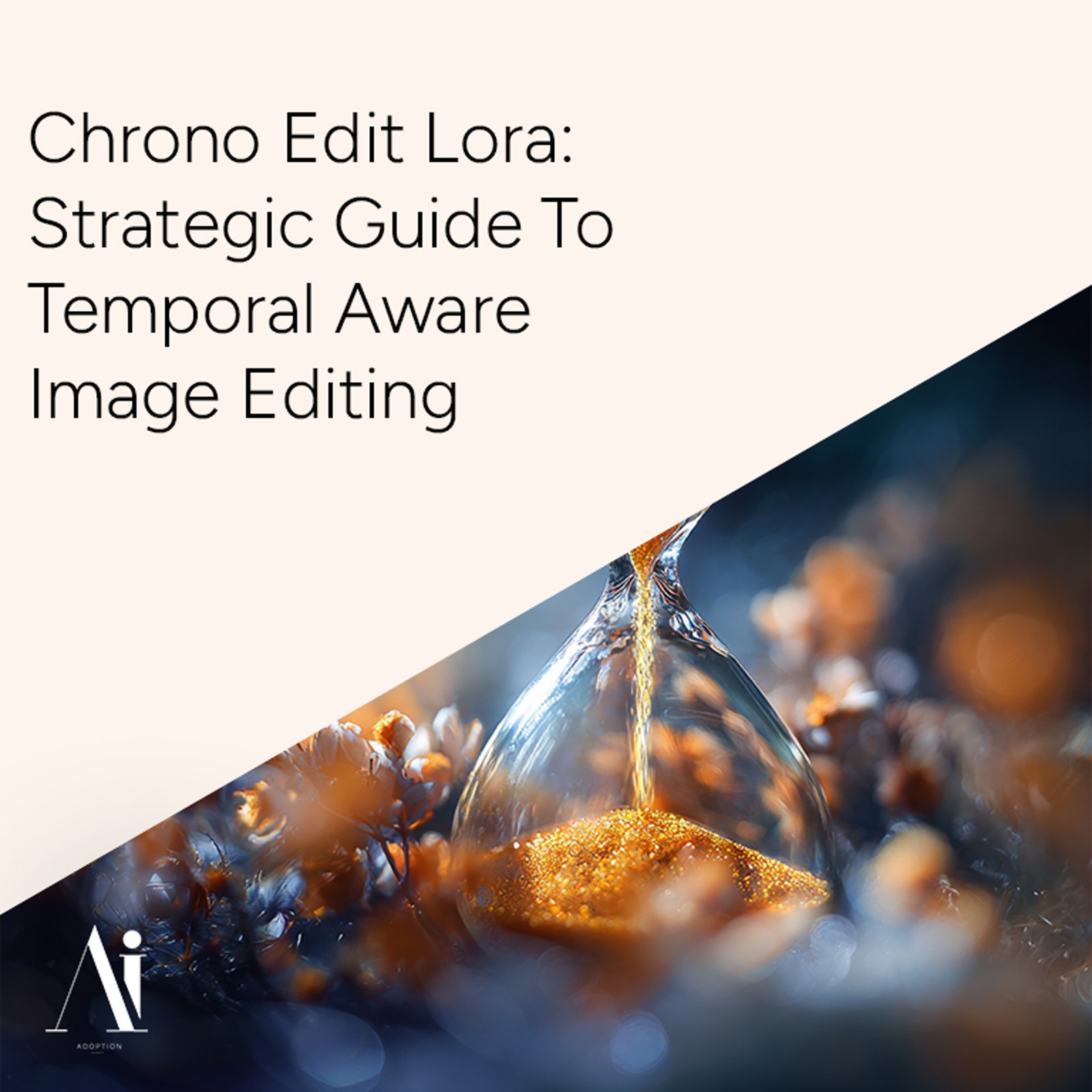
Chrono Edit is an open-source image editing framework that reframes editing as a two-frame video generation problem, using a video model with roughly fourteen billion parameters trained for temporal consistency and world simulation. It treats the original and edited images as consecutive frames in a short clip, letting the model reason about plausible motion, lighting changes, viewpoint shifts, and object interactions over time.
This temporal reasoning is implemented through additional tokens and a dedicated inference stage that enforces physically consistent trajectories between the input and output, solving common issues like warped limbs, broken perspective, or inconsistent reflections. Because the core model is a high-capacity video generator, it carries strong priors for structure and physics, so complex edits such as pose rotation, camera moves, and object manipulation remain stable even under strong prompts.
What Chrono Edit Lora Provides
Chrono Edit Lora exposes the Chrono Edit editing capabilities through an image-to-image endpoint with a Lora-based specialization layer. In practice, that means a production-friendly API where you send a reference image, describe the desired change, and receive an edited result that respects structure, lighting, and physical plausibility.
Vendors hosting Chrono Edit Lora typically support commercial usage, streamlined schemas, and web playgrounds so product teams can prototype before integrating into applications. Under the hood, the Lora injects the right behavior during the temporal reasoning phase, guiding the trajectory between input and output frames while the video backbone handles temporal coherence.
Why Temporal Reasoning Matters for Image Editing
Conventional image-only diffusion models operate frame by frame, which often leads to inconsistent anatomy, unstable textures, and broken reflections when edits become complex or when multiple related images need to match. By leveraging a video model, Chrono Edit uses temporal priors to keep objects coherent as they rotate, move, or interact with other elements, much like how a human animator thinks across frames.
Related service: We create 5 professional, high-quality AI images tailored for your products or website — delivered in 24 hours for just $100. Get 5 AI Images →
For design systems, this translates into more predictable edits across entire sequences such as e-commerce product rotations, storyboard panels, or marketing narratives. It reduces manual touch-up work and lowers the risk of off-brand or unrealistic imagery that can erode trust in generative assets at scale.
Market Context and Adoption Signals
Video and image diffusion models with temporal priors have emerged as a leading direction for world simulation and consistent editing, driven by large investments in creative AI and visual content platforms. Open frameworks such as Chrono Edit, combined with lightweight adapters like Loras and distilled checkpoints suitable for consumer GPUs, signal a shift from research prototypes to deployable, cost-aware tools.
Hosting providers that expose Chrono Edit Lora as managed endpoints with commercial terms are enabling product teams, marketing organizations, and independent creators to experiment without managing heavy infrastructure. This service-based model shortens the cycle from experimentation to integration in design tools, content management systems, and programmatic creative pipelines.
Best Practices for Chrono Edit Lora
Preserve Brand and Regulatory Compliance
- Use Loras to encode brand-safe palettes, typography-like shapes, or composition tendencies so the model gravitates toward approved aesthetics even when prompts are flexible.
- Combine this with review gates and automated checks where necessary, especially in regulated sectors or campaigns with strict representation guidelines.
- Maintain a clear separation between general-purpose Loras used across the company and sensitive Loras limited to specific teams or geographies. This avoids accidental leakage of styles or motifs that may be under license or limited to particular partners.
Optimize Prompts and Controls
- Although Chrono Edit brings strong inductive priors, prompt engineering and control inputs remain important for consistent results.
- Favor concise, descriptive prompts focused on the edit rather than fully restating the scene, and use masks or brush signals where the change must stay localized.
- Document prompt templates that work well per use case and bind them into your tools as preset options, reducing cognitive load on end users.
- Track which combinations of prompt, Lora, and parameters deliver the most reliable outcomes through simple logging and feedback collection.
Manage Performance and Cost
- Leverage distilled or quantized Chrono Edit checkpoints and efficient sampling strategies to keep generation steps modest while maintaining quality.
- For batch pipelines, schedule heavy jobs during low-demand windows and cache frequently used transformations when possible.
- Monitor latency, throughput, and failure modes from day one. Instrument your endpoints with metrics so you can adjust configuration, autoscaling, or model variants proactively as usage grows or new teams adopt the system.
Case Style Examples
Ecommerce Product Imagery
An e-commerce platform can use Chrono Edit Lora to generate new angles and lifestyle variations for existing product photos while preserving geometry and material realism. The base model ensures that rotations and interactions obey physical constraints, while a product-line Lora keeps textures, logos, and finishes consistent with the actual items.
Designers can request edits such as moving from studio shots to in-context scenes, adjusting lighting to match seasonal campaigns, or changing accessories around the main product without reshooting. This reduces photo production overheads and accelerates campaign rollout while maintaining visual trust for shoppers.
Character and Storytelling Pipelines
Studios and content platforms can harness Chrono Edit Lora to maintain character consistency across storyboards, key art, and promotional materials. The temporal reasoning backbone keeps faces, proportions, and outfits coherent as characters change pose, expression, or camera angle between frames.
Dedicated character Loras capture specific design language for each protagonist or franchise, ensuring that edits never drift into off-model versions even under strong creative direction. This improves continuity for long-form narratives and transmedia storytelling where audiences are sensitive to subtle changes in character appearance.
Design Tools and Creative Platforms
Visual design platforms can embed Chrono Edit Lora directly in their editor, offering users intuitive brushes and controls that leverage temporal reasoning without exposing technical complexity. Users simply draw guidance or describe an edit, and the system produces results that feel physically grounded and structurally aligned with the base artwork.
As model variants optimized for consumer GPUs become available, including distilled Chrono Edit and related upscaler Loras, desktop and local workflows can benefit without relying solely on cloud resources. This opens the door to offline-capable creative tools that still enjoy advanced temporal-aware editing.
Actionable Next Steps
- Define two or three priority use cases where temporal consistency and physical plausibility clearly matter, such as product rotations, character sequences, or interactive concept art.
- Pilot a hosted Chrono Edit Lora endpoint in a sandbox environment, integrating it into an existing design tool or web prototype for a small user group.
- Train one or two narrow Loras tied to real business needs—for example, a flagship product line or a hero character—and measure qualitative quality gains versus your current editing approach.
- Capture workflows that succeed, refine prompt templates and presets, and then formalize documentation and governance around model and Lora management.
- Scale by adding more Loras mapped to campaigns, brands, or tools, while standardizing observability, approval processes, and integration patterns across teams.
Conclusion
Chrono Edit Lora combines the temporal reasoning power of a video-based editing foundation model with the agility of low-rank adapters, offering a pragmatic path to high-quality, physically consistent image editing at scale. By treating edits as trajectories between frames and specializing behavior through compact Loras, organizations can unlock new creative workflows without compromising brand integrity, safety, or operational efficiency.
Teams that move early to structure their use cases, model portfolios, and governance around Chrono Edit Lora will be better positioned to turn generative editing from an experiment into a dependable production capability across marketing, product, and content operations.
Need Professional AI-Generated Images?
We create 5 professional, high-quality AI images tailored for your products or website — delivered in 24 hours for just $100.
Get 5 AI Images